
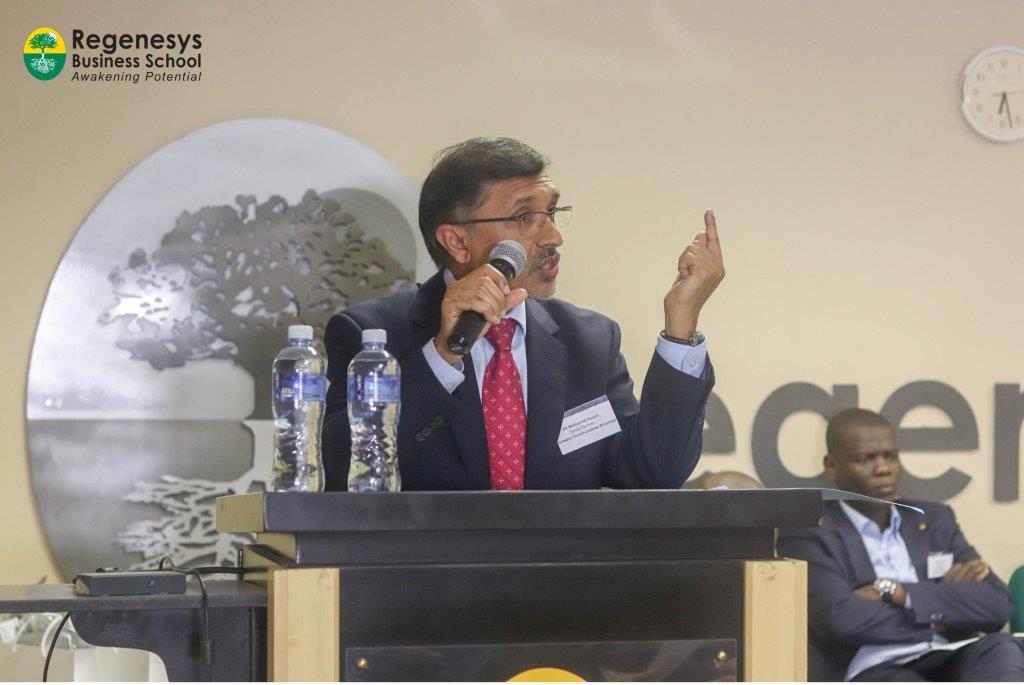
Mohamed Husain was one of the panellists, and as the evening turned out; he was the only panellist who was not from a political party or interest group. Mohamed had been invited as a legal expert to contribute insights on the legal position pertaining to expropriation of land with or without compensation.
In his presentation Mohamed gave a clear and careful exposition of section 25 of the Constitution; which in contemporary discourse has been the subject of much debate on whether it permits land expropriation without compensation; whether it should be amended in certain respects; or whether it adequately protects competing rights. His main submission was that the Constitution need not be amended as it adequately provides for expropriation with or without compensation. He pointed out that the construction of the Constitution permits a scenario where compensation is actually nominal to nil. He also submitted that the State has not done enough with its existing powers to achieve adequate land reform. He did however, caution against careless expropriations that have no regard for the economy as he warned that this would lead to inevitable downgrades of the economy. His presentation laid the foundation for the speakers from the various political parties and interest groups.
The land question has proven to be an extremely emotive one which leaves South Africa a sharply divided nation. This was evident in the submissions that followed.
Democratic Alliance (DA) Shadow Deputy Minister of Rural Development and Land Reform Ken Robertson called on government to release land in its hand, revise its national budget and stamp out corruption to help fast-track land reform.
Deputy CEO of Afri-Forum Ernest Roets supports land reform; he however insists that expropriation without compensation is not the solution.
Youth League President of the Congress of the People (COPE) took a view substantially similar to Afri-Forum and the DA.
African National Congress (ANC) NEC member Ronald Lamola, vowed that the ANC will introduce the Expropriation Bill in Parliament in the next few months to fast-track the expropriation of land without compensation, and confirmed the ruling party’s view that expropriation without compensation is seen as a valuable tool in achieving land reform.
Deputy President of the Black First – Land First Zanele Lwana was relentless in her call for a direct reversal of the violent land dispossessions.
Louis Meintjies, the president of the Transvaal Agricultural Union (TAU), sought to dispel the narrative that Black people were displaced. His argument was that a holistic view of the nation’s history reveals that land dispossessions occurred to people of all races and cultures and further that not all White ownership of land arose through violent means but rather by treaties and agreements with indigenous peoples.
Motsepe Matlala, the President of the National Union of Farmers South Africa, argued that land reform is an urgent national demand that can only be relieved by amending the Constitution so as to avail resources and means of production to the Black majority.
The discussion was opened up to the floor for questions and comments before being closed. It provided all in attendance an opportunity to debate differing views on the land question as well as an opportunity to network over some choice refreshments.